Milton and the English Revolution by Christopher Hill
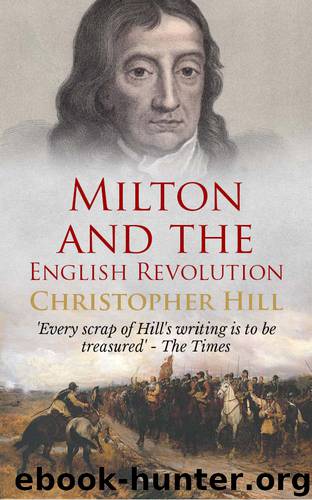
Author:Christopher Hill [Hill, Christopher]
Language: eng
Format: azw3, mobi, epub
Publisher: Endeavour Press
Published: 2015-09-02T04:00:00+00:00
Chapter Twenty-Four – Approaches to Antinomianism
‘Whosoever is born of God doth not commit sin; for his seed remaineth in him: and he cannot sin, because he is born of God.’
i John 3.9
*
‘’Tis not the place but the state which makes heaven and happiness.’
Sir Isaac Newton, quoted by Manuel (1974), p. 101
The religion of the heart
Milton’s Arminianism, his acceptance of adult baptism, his political libertinism and his perilous path on the fringes of antinomianism, all derive from the Protestant emphasis on the religion of the heart. In sacraments it is the attitude of the recipient that matters, not the ceremony. ‘The matter is not great which way we turn our faces,’ Ralegh wrote, ‘so the heart stand right.’[1118] Sir Thomas More had long ago shrewdly pointed out how easily the Protestant emphasis on the motive of the heart could slide over into antinomianism.[1119] In the De Doctrina Milton quotes i Samuel 16:7: ‘Jehovah looks on the heart’ at a crucial point in his discussion of freedom of the will.[1120]
To prayer, repentance and obedience due,
Though but endeavoured with sincere intent,
Mine ear shall not be slow, mine eye not shut
the Father says in Paradise Lost (P.L. III. 191-3).
A man may be a heretic in the truth, if he takes over at second hand a doctrine which he has not made his own: conversely, a man cannot be a heretic if he follows his conscience sincerely – even ‘though against any point of doctrine by the whole church received’. The heretic is ‘he who follows the church against his conscience and persuasion grounded on the Scripture’. This is the basis for Milton’s theory of toleration: no Protestant ‘of what sect soever, following Scripture only...ought, by the common doctrine of protestants, to be forced or molested for religion’. ‘No man in religion is properly a heretic at this day but he who maintains traditions or opinions not probable by Scripture (who, for aught I know, is the papist only)’.[1121] (cf. Luther: ‘Neither pope nor bishop nor anyone else has the right to impose so much as a single syllable of obligation upon a Christian man without his own consent.’)[1122] ‘Chiefly for this cause do all true protestants account the Pope Antichrist,’ Milton continued; ‘for that he asssumes to himself this infallibility over both the conscience and the Scripture.’[1123] Hence the arguments for complete toleration for all Protestants do not apply to papists.
A great many conclusions follow from this absolute emphasis on conscience, on sincerity. The efficacy of any sacrament depends on the proper attitude of the recipient, and therefore ‘Infants are not fit for baptism’, since ‘they cannot believe or undertake an obligation.’ Attendance at church is not necessary: ‘the worship of the heart is accepted by God even where external forms are not in all respects observed.’[1124] But Samson Agonistes suggests that Milton agreed with Muggleton that we should abstain from attending the worship of the restored Church of England.[1125]
The same emphasis gives a standard by which to judge of obscenity. No words or
Download
Milton and the English Revolution by Christopher Hill.mobi
Milton and the English Revolution by Christopher Hill.epub
This site does not store any files on its server. We only index and link to content provided by other sites. Please contact the content providers to delete copyright contents if any and email us, we'll remove relevant links or contents immediately.
Waking Up in Heaven: A True Story of Brokenness, Heaven, and Life Again by McVea Crystal & Tresniowski Alex(37808)
Empire of the Sikhs by Patwant Singh(23084)
We're Going to Need More Wine by Gabrielle Union(19046)
Hans Sturm: A Soldier's Odyssey on the Eastern Front by Gordon Williamson(18590)
Leonardo da Vinci by Walter Isaacson(13336)
The Radium Girls by Kate Moore(12028)
Tools of Titans by Timothy Ferriss(8393)
Educated by Tara Westover(8053)
How to Be a Bawse: A Guide to Conquering Life by Lilly Singh(7486)
Permanent Record by Edward Snowden(5846)
The Last Black Unicorn by Tiffany Haddish(5635)
The Rise and Fall of Senator Joe McCarthy by James Cross Giblin(5280)
Promise Me, Dad by Joe Biden(5153)
The Wind in My Hair by Masih Alinejad(5095)
A Higher Loyalty: Truth, Lies, and Leadership by James Comey(4960)
The Crown by Robert Lacey(4814)
The Iron Duke by The Iron Duke(4354)
Joan of Arc by Mary Gordon(4109)
Stalin by Stephen Kotkin(3965)
